A synthetic fragment related to Thymosin beta-4, examined in the context of actin, cell migration, and tissue repair
Overview
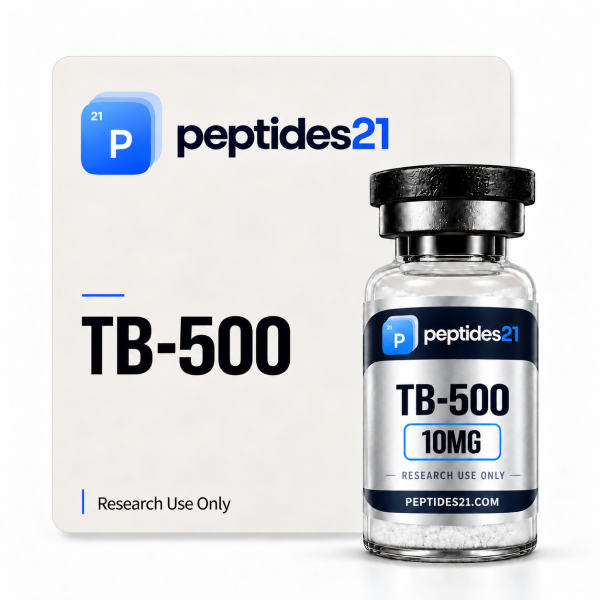
TB-500 is a common name for a synthetic peptide related to Thymosin beta-4, a natural 43-amino-acid protein found in most cells of the body. Thymosin beta-4 is known as a G-actin-binding protein and takes part in regulating cytoskeletal dynamics, cell motility, cell migration and tissue-repair processes [1,3]. The key distinction runs between full-length Thymosin beta-4 and TB-500. Doping-testing literature and regulatory documents usually identify TB-500 as a short fragment of Thymosin beta-4, mainly the sequence LKKTETQ, and sometimes as the acetylated version Ac-LKKTETQ, that is, amino acids 17 to 23 of the full-length protein [1,2,7]. That distinction matters a great deal. A large part of the research evidence on wound healing, cornea, heart and angiogenesis concerns full-length Thymosin beta-4, and not necessarily TB-500 as a short fragment, so conclusions from Thymosin beta-4 studies cannot be transferred automatically to TB-500 [3-6].
Biological Mechanism
Thymosin beta-4 binds G-actin, that is, monomeric actin, and in doing so affects how much actin is available for building actin filaments within the cell [3]. Actin dynamics are essential to changes in cell shape, motility, migration, cell division and the response to injury. Wound healing asks cells to move to the site of injury, adhere to the matrix, produce new proteins and reorganize the tissue. Early research showed Thymosin beta-4 accelerating wound healing in experimental models, in part through effects on the migration of keratinocytes and endothelial cells [3]. Later research suggested that the actin-binding region of Thymosin beta-4 promotes angiogenesis, that is, the formation of new blood vessels [4]. Angiogenesis can support tissue repair, yet it is also a sensitive biological process, involved in conditions such as chronic inflammation and tumors, so activity of that sort requires careful safety evaluation.
Research Evidence
A 2012 study characterized the acetylated fragment of amino acids 17-23 of Thymosin beta-4, identified with TB-500, in the context of a substance with doping potential [1]. Another study developed methods for detecting TB-500 in biological fluids in horses, which underlines that the name TB-500 circulates mainly in the context of drug testing and unapproved use rather than as an established medicine [2]. Alongside that, studies of full-length Thymosin beta-4 have produced significant biological findings. Skin studies found promotion of wound healing [3]. A study in the FASEB Journal found the actin-binding region contributing to angiogenesis [4]. A 2004 Nature study found that Thymosin beta-4 activates integrin-linked kinase, supports the migration of cardiac and endothelial cells, reduces cell death and promotes cardiac repair in experimental models [5]. In ophthalmology, research solutions of Thymosin beta-4 have been tested in dry eye and in conditions of corneal epithelial injury, including controlled studies of topical formulations [6]. Here too the work concerns mainly full-length Thymosin beta-4 or defined formulations, and not direct proof regarding TB-500 as a short fragment.
Where TB-500 and Full-Length Thymosin Beta-4 Get Conflated
One of the central problems in the literature and discussion around TB-500 is the conflation of the short fragment with full-length Thymosin beta-4. Doping research identifies TB-500 as the fragment Ac-LKKTETQ or the sequence LKKTETQ, whereas full-length Thymosin beta-4 is a longer protein of 43 amino acids [1,2]. When a study describes the biological activity of full-length Tβ4, no one should assume automatically that the same activity is fully reproduced in the short fragment. The reason is that proteins and peptides do not act through a single "active region" alone. The full structure can affect stability, binding to other proteins, degradation, tissue penetration, biological distribution and interactions with additional pathways. The LKKTETQ fragment is associated with the actin region and cell migration, yet full-length Tβ4 may carry additional properties that the fragment does not reproduce [1-5]. What relatively more advanced clinical evidence exists comes not from TB-500 as a systemic product but from research formulations of full-length Thymosin beta-4, mainly in the eye and the skin [6-8]. RGN-259, for example, is an ophthalmic preparation tested in dry eye and neurotrophic keratopathy [7,8]. Those results are important, but they do not prove the efficacy of short TB-500 in tendon, muscle or ligament injuries. Actin dynamics, cell migration and angiogenesis are pathways essential to healing and also pathways to interpret with caution. Cell motility and blood-vessel formation help close a wound and repair tissue, while in other settings they may be involved in chronic inflammation, fibrosis and tumor processes. The interest in TB-500 therefore rests not on "rapid healing" but on understanding a cellular repair system that can be beneficial or problematic depending on the biological context [3-5]. From a regulatory standpoint, the FDA and anti-doping bodies treat TB-500 as a substance carrying quality, identity and safety issues. Problems of acetylation, sequence identification, peptide-related impurities and API characterization are not marginal, because a short peptide that is incorrect or contaminated can differ significantly from the molecule that was studied [1,2,8].
Safety & Regulation
The FDA refers to Thymosin beta-4 fragment LKKTETQ, also known as TB-500, as a substance that may raise safety concerns in the context of compounding. The concerns run to immunogenicity, aggregation, peptide-related impurities and challenges in characterizing the active substance, and a lack of adequate human exposure data is noted for drug products containing the fragment [7]. In competitive sport, Thymosin beta-4 and its derivatives, TB-500 included, appear in contexts of prohibited substances or doping testing [2,8]. That fact carries particular relevance because TB-500 is common in discussion around recovery and sports injuries while the direct clinical evidence in humans is scarce. A further safety limitation lies in the biological nature of the pathway: promoting cell migration and angiogenesis may be beneficial in the context of tissue repair and problematic in other situations. Healing findings in experimental models therefore support no inference of general safety in humans.
Indirect Clinical Evidence Versus Broad Usage Claims
Research on full-length Thymosin beta-4 in the eye and the skin offers an interesting basis for understanding epithelial healing, cell migration and reduction of inflammation [6-8]. Carrying those findings over to the discussion of TB-500 in musculoskeletal injuries, however, creates an evidential leap. A corneal defect or a superficial skin wound differs greatly from a tendon tear, a muscle injury or repair of heart tissue, since each tissue brings different blood supply, mechanical loads, target cells and healing pathways. The doping studies themselves also stress that this is a molecule examined in the context of detection and analytical chemistry, not necessarily in a therapeutic context in humans [1,2]. That a fragment can be detected in urine or plasma proves no clinical activity. What it does clarify is that there is a problem of substance identification, a difference between the fragment and the full molecule, and a need to keep marketing names separate from precise chemistry. On safety, the main gap is the absence of direct human exposure data for TB-500 as a short fragment. Data on full-length Tβ4 in topical formulations do not cover systemic exposure to a short fragment. Risk assessment should therefore take in not only reported side effects but also questions about immunogenicity, stability, degradation products, unwanted angiogenesis and regulation in sport [1,2,8].
Summary
TB-500 is a synthetic fragment related to an active region of Thymosin beta-4 and is not necessarily identical to the full protein [1,2]. Thymosin beta-4 has been studied in actin pathways, cell migration, angiogenesis and tissue processes [3-6], but the direct evidence on TB-500 as a short fragment in humans is very limited, and the FDA notes a lack of human exposure data alongside quality and characterization concerns [7]. The substance is intended for laboratory research use only.
Selected Research Sources
- Esposito S. et al. Synthesis and characterization of the N-terminal acetylated 17-23 fragment of thymosin beta 4 identified in TB-500. Drug Testing and Analysis, 2012. PMID: 22962027
- Ho E.N.M. et al. Doping control analysis of TB-500, a synthetic version of an active region of thymosin beta 4, in equine urine and plasma. Journal of Chromatography A, 2012. PMID: 23084823
- Malinda K.M. et al. Thymosin beta4 accelerates wound healing. Journal of Investigative Dermatology, 1999. PMID: 10469335
- Philp D. et al. The actin binding site on thymosin beta4 promotes angiogenesis. FASEB Journal, 2003. PMID: 14500546
- Bock-Marquette I. et al. Thymosin beta4 activates integrin-linked kinase and promotes cardiac cell migration, survival and cardiac repair. Nature, 2004. PMID: 15565145
- Sosne G. et al. Thymosin beta 4 ophthalmic solution for dry eye: a randomized, placebo-controlled, Phase II clinical trial. Clinical Ophthalmology, 2015. PMID: 26056426
- U.S. Food and Drug Administration. Safety risks associated with certain bulk drug substances nominated for use in compounding. Entry for Thymosin beta-4 fragment LKKTETQ, also known as TB-500. FDA.gov
- USADA. 2018 Prohibited List: Summary of Major Changes, addition of Thymosin beta-4 and derivatives such as TB-500. USADA.org


Reviews
There are no reviews yet.