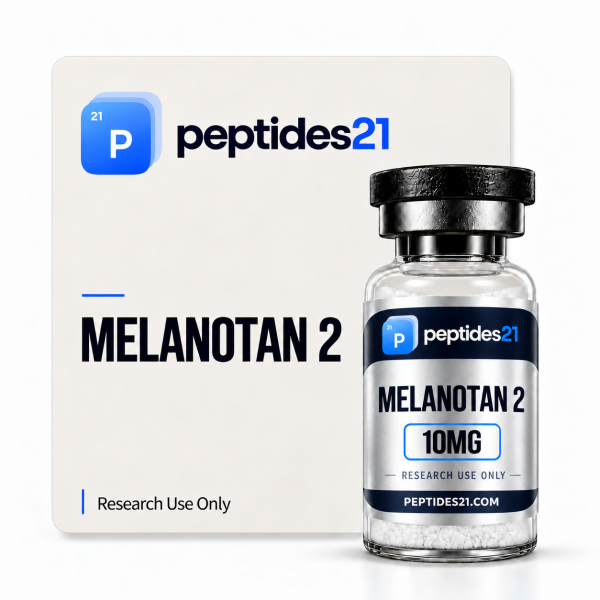
A non-selective melanocortin analog examined for pigmentation and central effects, with no pharmaceutical approval
Background
Melanotan 2 (MT-II) is a cyclic synthetic peptide developed as an analog of α-MSH. Selectivity is where it parts ways with afamelanotide (Melanotan 1): as a melanocortin agonist MT-II is the less selective of the two, reaching several receptors rather than skin MC1R alone [1,2]. Work from the 1990s demonstrated that it can raise pigmentation in humans [1]. Central effects on libido and erection surfaced afterward, and those findings prompted development of further molecules from the same receptor family [2,3]. No FDA approval exists for MT-II, whether for tanning or any therapeutic indication, and the agency raises serious safety concerns about compounded preparations containing it, citing reported cases of grave adverse events [4].
Proposed Mechanism
The melanocortin system comprises several receptors from the GPCR family. When MC1R is activated in melanocytes, cAMP rises and eumelanin production increases, which can darken the skin. MT-II is not limited to MC1R and can also activate melanocortin receptors in the central nervous system [2]. That wider reach explains why early experiments recorded not only changes in pigmentation but also nausea, yawning, and changes in libido and erectile responses [2,3]. Put differently, the same non-selectivity that broadens biological activity also complicates the side-effect profile. MT-II should therefore not be treated as a “color peptide” confined to the skin; it is a substance with systemic activity across different melanocortin pathways.
The Evidence Base
A 1996 study tested MT-II in humans and reported increased pigmentation after a series of experimental exposures [1]. Further small studies examined its effect in men with erectile dysfunction and documented an erectile response and increased libido in some participants [2,3]. Such work matters for demonstrating pharmacological activity, but it is no basis for cosmetic or medical approval: the studies were small, comparatively old, and offer no long-term information on repeated use in a broad population. Most of the later literature consists of observational studies, user reports and case reports of side effects — a weaker basis for judging benefit, yet valuable for surfacing safety signals.
Skin Pigment vs. Central Activity
The gap between Melanotan 1 and Melanotan 2 goes beyond the name. Afamelanotide was developed around MC1R activity and received a specific medical approval for EPP, while MT-II activates several receptors and shows more central effects [2]. Changes in pigmentation can therefore appear alongside effects with no direct connection to the skin. Nausea and yawning were common in the early studies, and the erection studies observed sexual activity that was not necessarily dependent on ordinary sexual stimulation [2,3]. Because the profile spans multiple systems, a safety assessment of MT-II takes more than monitoring skin color alone.
Regulatory Status & Safety
Melanotan II appears on the FDA’s list of substances that may present significant safety risks in the context of compounding. The agency cites concerns regarding immunogenicity and peptide-related impurities, along with case reports of serious adverse events including priapism, sympathomimetic syndrome, posterior reversible encephalopathy syndrome and melanoma [4]. A case report does not necessarily prove that the peptide caused the event: cases of melanoma have been published following use of MT-II, but other risk factors such as intensive UV exposure were sometimes present as well [5], so a causal link to melanoma is not proven at the level of a controlled trial. Even so, serious safety signals surfacing at all, together with the absence of large long-term safety studies, leaves considerable uncertainty. A further complication: should moles or pigmented lesions shift in appearance, routine skin monitoring becomes harder to carry out properly.
Case Reports, Causality and Material Quality
Rare effects are exactly what case reports are good at catching, yet such reports yield no incidence figure and cannot establish cause. A case of priapism following MT-II, for instance, fits the central melanocortin mechanism described in the early studies and is thus regarded as a plausible biological signal [6]. The melanoma question is more complex and would require long-term epidemiological studies. Mechanism aside, unapproved material brings its own open questions — chemical identity, purity, sterility, degradation products. Where production has not gone through approved pharmaceutical manufacturing, that uncertainty becomes part of the risk profile, inseparable from any evaluation of the peptide.
Bottom Line
Acting on melanocortin receptors, Melanotan 2 is a cyclic α-MSH analog. Its effect on pigmentation was examined in early work, which never produced an approved medical or cosmetic use [1-3], while the FDA raises substantial concerns about the safety and the quality of MT-II products and points to reported cases of grave adverse events [4-6]. The material is unapproved and supplied for laboratory research use only.
Selected Research Sources
- Dorr R.T. et al. Evaluation of Melanotan-II, a superpotent cyclic melanotropic peptide in a pilot phase-I clinical study. Life Sciences, 1996. PMID: 8637402
- Wessells H. et al. Melanocortin receptor agonists, penile erection, and sexual motivation: human studies with Melanotan II. International Journal of Impotence Research, 2000. PMID: 11035391
- Wessells H. et al. Synthetic melanotropic peptide initiates erections in men with psychogenic erectile dysfunction. Journal of Urology, 1998. PMID: 9679884
- U.S. Food and Drug Administration. Certain Bulk Drug Substances for Use in Compounding that May Present Significant Safety Risks. Entry for Melanotan II.
- Hjuler K.F. et al. Melanoma associated with the use of Melanotan-II. Dermatology, 2014. PMID: 24355990
- Dreyer B.A. et al. Melanotan-induced priapism: a hard-earned tan. BMJ Case Reports, 2019. PMID: 30796078


Reviews
There are no reviews yet.