A copper-bound peptide examined in research on skin, tissue repair, extracellular matrix biology and the regulation of inflammation
Overview
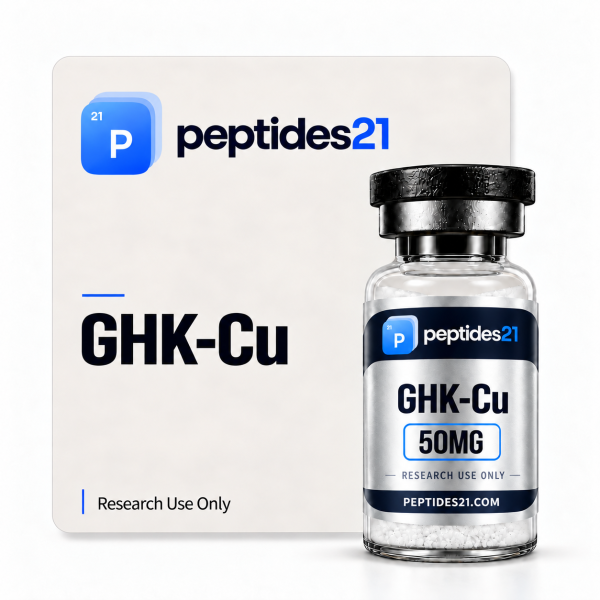
GHK-Cu pairs a three-residue peptide, GHK, with a divalent copper ion. The GHK motif is built from glycine, histidine and lysine. Once copper is chelated, the resulting complex appears in the literature as glycyl-L-histidyl-L-lysine-Cu2+, and in dermatology and cosmetic chemistry under the name Copper Tripeptide-1 [1,2]. GHK itself was first picked out in the 1970s as a constituent of human plasma with biological activity on cells. Its chemical sequence was mapped afterwards, and the molecule turned out to bind copper with comparatively high affinity [1,2]. What makes it scientifically attractive is that it brings together two biologically meaningful components at once: a short peptide that behaves as a signal, and copper, a trace element that enzymes handling collagen, elastin, antioxidant defense and tissue repair depend on [3,6]. The bulk of the GHK-Cu literature deals with skin and connective tissue, though the scope is wider than cosmetics alone. Published work has looked at the peptide in relation to wound healing, fibroblast activity, synthesis of collagen and glycosaminoglycans, regulation of inflammation, remodeling of the extracellular matrix and the expression of genes tied to tissue repair [4-8].
Biological Mechanism
Cells sit inside the extracellular matrix, a mesh of collagen, elastin, proteoglycans, glycosaminoglycans and additional proteins that surrounds them and gives tissue its architecture. Within skin and connective tissue, the quality of that matrix matters at least as much as the sheer quantity of collagen. Orderly repair calls for damaged tissue to be broken down in a controlled way, for cells to migrate, for a fresh matrix to be laid down and for collagen fibers to be reorganized. Work in fibroblast cultures reported that low concentrations of GHK-Cu raised collagen synthesis while cell numbers stayed flat [4]. Because output changed without the culture simply growing larger, the observation is read as regulatory activity of the peptide on the cell rather than a generic stimulation of the cell culture. A separate investigation reported that GHK-Cu increased synthesis of glycosaminoglycans, chiefly dermatan sulfate and heparan sulfate, both of which are important to the structure and function of the extracellular matrix [5]. Later review articles propose that GHK-Cu also operates by shifting the balance between construction and breakdown of the matrix. It has been linked with altered metalloproteinase activity, with metalloproteinase inhibitors, with the fibroblast response, and with pathways connected to inflammation and oxidative stress [6,8]. On that reading, its activity is not reducible to 'promoting collagen'; it concerns a broader remodeling of tissue.
Research Evidence
An animal experiment reported in the Journal of Clinical Investigation examined what GHK-Cu did to experimental wounds in rats. The authors described promotion of connective-tissue accumulation at the wound site together with shifts in collagen and matrix measures [7]. Observations of that kind are consistent with a possible role for the complex during the structural repair phase of tissue. A 2012 paper in Genome Medicine approached GHK from the angle of gene expression instead. The group identified a gene-expression signature associated with destruction of lung tissue in emphysema, and reported that GHK surfaced as a molecule able to reverse part of that expression pattern in cellular and bioinformatic models [8]. Nothing in that work establishes treatment of lung disease; what it shows is that GHK may touch biological programs involving connective tissue, inflammation and repair. On the skin side, small clinical studies and dermatological preparations exist as well, but GHK-Cu itself, other copper complexes and blended cosmetic formulations have to be kept apart. A favorable result with one particular preparation is not evidence that every product containing Copper Tripeptide-1 behaves the same way or with the same potency.
Biological Activity Versus a Cosmetic Outcome
Interpreting the GHK-Cu literature is difficult largely because of the jump from cellular measures to clinical ones. A study showing more collagen synthesis in fibroblasts does not guarantee the same effect in living skin, which has an epidermal barrier, blood flow, enzymatic degradation, immune responses and significant differences between formulations [4,9]. The level of evidence should therefore be read by context: culture work explains mechanism, animal work points toward healing potential, and small clinical studies test the practical outcome of one particular preparation. A second consideration is free copper versus a peptide-copper complex. Copper on its own can take part in unwanted oxidation reactions, whereas being bound to a peptide may alter its availability and the way it is delivered to cells [3]. GHK-Cu is consequently not equivalent to a copper supplement or to general copper exposure. Its biological activity is contingent on the architecture of the complex, its stability, its concentration, the surrounding chemistry and whether it can reach the target tissue. In the genetic study on emphysema, GHK appeared as a molecule capable of shifting gene-expression signatures tied to lung-tissue destruction, cytoskeletal organization and collagen remodeling [8]. That widens interest in the peptide past the skin while simultaneously exposing the limitation of translation: altering gene expression in cell culture is not a proven treatment for a chronic disease. The research value lies in the fact that GHK-Cu offers a model for understanding how short peptides, trace metals, the extracellular matrix and cellular repair programs relate to one another. Dermatologically, the question worth asking is not simply whether GHK-Cu 'increases collagen', but whether tissue quality changes over time. Proper remodeling covers collagen formation, breakdown of damaged collagen, fiber organization, regulation of inflammation and support of glycosaminoglycans. A 2015 review argues that GHK is involved in several of those axes in parallel, metalloproteinases and their inhibitors included [6]. Describing it as a peptide related to matrix repair is therefore more accurate than the narrower description of it as an anti-aging ingredient.
Safety & Regulation
How GHK-Cu looks from a safety standpoint depends heavily on the route of exposure; a topical skin preparation and systemic exposure are not the same situation. Dermal formulations are assessed on pH, stability, permeability, carriers and accompanying substances, not on the peptide alone. A pre-formulation study found GHK-Cu to be sensitive to degradation under certain conditions, which makes stability and manufacturing quality a significant part of any evaluation [9]. The FDA notes that compounded injectable preparations containing GHK-Cu may raise concerns of immunogenicity, aggregation, peptide-related impurities and insufficient characterization of the active substance, and that human data for assessing safety by such routes of exposure are limited [10]. Drawing a line between topical dermatological research and systemic exposure is therefore central.
Limits of Translation and Quality Measures
Anyone evaluating preparations that contain GHK-Cu also has to weigh the question of formulation. A peptide that holds up in a test tube will not automatically hold up in a finished product, and development work has found GHK-Cu to be sensitive to conditions of pH, oxidation and hydrolytic degradation [9]. Skin additionally demands penetration through the stratum corneum, which is a particularly effective biological barrier. The same molecule can thus look impressive in the laboratory yet give a variable result across different preparations. A deeper issue is the difference between young skin, aging skin and damaged skin. Aging tissue shows changes in fibroblasts, a decline in collagen quality, an increase in degradation enzymes, a decrease in water content and a shift in low-grade chronic inflammation. Part of the reason GHK-Cu has been studied is that it may affect several of those characteristics together [6,8]. Proving a stable clinical effect, however, would require studies that measure more than external appearance — dermal thickness, collagen organization, elasticity, barrier function and safety over time.
Summary
Among copper tripeptides, GHK-Cu is one of the most thoroughly investigated in relation to skin and connective tissue. The available evidence points toward possible involvement with collagen, glycosaminoglycans, fibroblasts and the extracellular matrix [4-8]; most of that knowledge, though, comes from cell studies, animal studies and small clinical studies, and extension to systemic uses is not sufficiently established [9,10]. The material is intended for laboratory research use only.
Key Research References
- Pickart L., Thaler M.M. Tripeptide in human serum which prolongs survival of normal liver cells and stimulates growth in neoplastic liver. Nature New Biology, 1973. PMID: 4349963
- Schlesinger D.H., Pickart L., Thaler M.M. Growth-modulating serum tripeptide is glycyl-histidyl-lysine. Experientia, 1977. PMID: 858356
- Pickart L. et al. Growth-modulating plasma tripeptide may function by facilitating copper uptake into cells. Nature, 1980. PMID: 7453802
- Maquart F.X. et al. Stimulation of collagen synthesis in fibroblast cultures by the tripeptide-copper complex glycyl-L-histidyl-L-lysine-Cu2+. FEBS Letters, 1988. PMID: 3169264
- Wegrowski Y. et al. Stimulation of sulfated glycosaminoglycan synthesis by the tripeptide-copper complex glycyl-L-histidyl-L-lysine-Cu2+. Life Sciences, 1992. PMID: 1522753
- Pickart L., Vasquez-Soltero J.M., Margolina A. GHK Peptide as a Natural Modulator of Multiple Cellular Pathways in Skin Regeneration. BioMed Research International, 2015. PMID: 26236730
- Maquart F.X. et al. In vivo stimulation of connective tissue accumulation by the tripeptide-copper complex glycyl-L-histidyl-L-lysine-Cu2+ in rat experimental wounds. Journal of Clinical Investigation, 1993. PMID: 8227353
- Campbell J.D. et al. A gene expression signature of emphysema-related lung destruction and its reversal by the tripeptide GHK. Genome Medicine, 2012. NIH.gov
- Badenhorst T. et al. Physicochemical characterization of GHK-Cu for dermal delivery. Pharmaceutical Development and Technology, 2016. PMID: 25384620
- U.S. Food and Drug Administration. Safety risks associated with certain bulk drug substances nominated for use in compounding. Entry for GHK-Cu. FDA.gov


Reviews
There are no reviews yet.