Overview
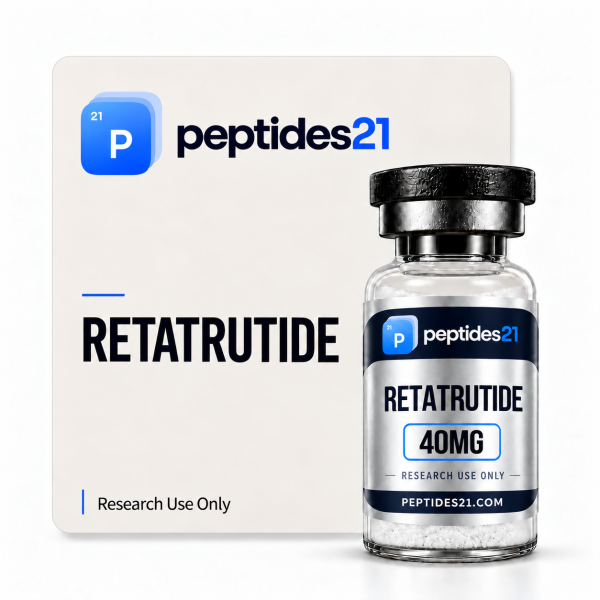
Retatrutide, carried through research under the code LY3437943, is an investigational peptide that agonizes three receptors at once: GLP-1, GIP, and glucagon. It came out of the new generation of incretin and metabolic drugs, a class built to act on appetite, insulin secretion, body weight, and energy expenditure in parallel [1,2]. What sets Retatrutide apart is that third arm. This is neither a GLP-1 agonist on its own nor merely a dual agonist of the kind that engages GLP-1 and GIP; activity at the glucagon receptor is layered on as well, which yields a more complex biological profile. Glucagon is best known as the hormone that raises blood glucose, yet activation of its receptor may also be associated with increased energy expenditure and with changes in lipid metabolism [1,2]. As of June 2026 the molecule sits in advanced clinical development, with Phase 2 studies published in 2023 and a Phase 3 study in type 2 diabetes published in 2026 [1-3]. The clinical literature behind it is therefore more substantial than for many other research peptides, though a distinction between trial results on one hand and approval and broad clinical use on the other is still required.
How It Works Biologically
GLP-1 is an incretin hormone released after a meal that enhances glucose-dependent insulin secretion, suppresses postprandial glucagon, slows gastric emptying, and increases satiety. GIP, a second incretin, affects insulin secretion and beta-cell function and carries effects in adipose tissue and across the broader metabolic system [1,2]. On top of these sits the glucagon receptor. Glucagon increases glucose production in the liver; at the same time, controlled activation of the glucagon pathway may raise energy expenditure, affect liver fat, and contribute to weight loss where it is combined with GLP-1 and GIP activity [1,2]. Striking a balance between reduced appetite, improved glycemic control, and an effect on metabolism is the intent behind the triple combination. Such a mechanism is not simpler than the GLP-1 mechanism, however — it is more complex. Long-term studies are consequently required to assess cardiac, hepatic, pancreatic, and metabolic safety, not only weight loss and HbA1c.
What the Studies Report
A Phase 2 study published in the New England Journal of Medicine in 2023 examined Retatrutide in adults with obesity. Significant weight loss was reported at 48 weeks, dose-dependent and of high magnitude relative to previous generations of incretin drugs [1]. That study placed Retatrutide among the leading candidates in the field of metabolic treatment, while the follow-up duration and sample size still marked an intermediate stage in development. A second Phase 2 study, published in the Lancet in 2023, looked at patients with type 2 diabetes and showed improvement in HbA1c alongside weight loss, with side effects mainly of the gastrointestinal system — the pattern already familiar across the family of incretin agonists [2]. Then, in 2026, the Lancet published a Phase 3 study of the TRANSCEND-T2D-1 type in patients with type 2 diabetes, presenting significant improvement in glycemic control and body weight and adding an important clinical layer beyond the Phase 2 work [3]. Persistence over years, cardiovascular outcomes, rare effects, and the effect after treatment discontinuation nonetheless remain open questions for further follow-up.
Advanced Clinical Development and the Current Evidence Picture
Past the Phase 2 studies, Retatrutide moved into a broad Phase 3 program. Registration for TRIUMPH-1 covers a Phase 3 study in participants who have obesity or overweight, subpopulations with obesity-related complications included [5]. Company data published in 2026 described significant weight loss in that study, though an initial announcement from a company and a full peer-reviewed article are not the same thing [6]. TRIUMPH-4 turned to a specific population: participants with obesity or overweight together with osteoarthritis of the knee [7]. Its preliminary data emphasized improvement in pain and function according to WOMAC measures as well as weight loss. A cautious reading has to allow for the possibility that part of the improvement in pain follows from a reduction in the mechanical load on the knee rather than from direct anti-inflammatory activity of the molecule — a distinction that matters because it separates a systemic metabolic effect from a direct effect on joint tissue. MASLD, a fatty liver disease associated with metabolic disorder, is another area. A Phase 2a study published in Nature Medicine found that Retatrutide reduced liver fat on a research measurement, with the reduction associated with changes in weight, abdominal fat, and metabolic measures [4]. That finding sits well with the biological rationale of triple agonism, since the liver is a central organ in the glucagon, lipid, and insulin-sensitivity pathways. Depth of clinical program is what most clearly separates Retatrutide from many other research peptides: there are randomized controlled trials in humans, Phase 2 and Phase 3 included [1-3,5]. Even an advanced clinical program, though, leaves questions that only time answers — the effect after treatment discontinuation, preservation of lean body mass, cardiovascular outcomes, liver and pancreas function, uncommon neurological effects, and patterns of persistence and tolerability in a broad population. The value of Retatrutide today therefore lies in the combination of strong clinical results with the need to complete regulatory follow-up and full publication of all outcomes.
Safety & Limitations
Side effects seen commonly in studies on Retatrutide were mainly in the gastrointestinal system: nausea, diarrhea, vomiting, and constipation [1,2]. Changes in heart rate or additional metabolic measures were reported in some studies as well, so the safety assessment does not stop at gastrointestinal tolerability. Activity at the glucagon receptor warrants particular attention. The combination with GLP-1 and GIP may balance part of the effect on glucose, yet glucagon remains a central metabolic pathway in the liver. Assessing the effects on glucose, liver, lipids, appetite, lean body mass, and cardiovascular systems over time is therefore important. Retatrutide presents impressive clinical data at this stage, but regulatory evaluation and long-term follow-up are still needed. Rare or late effects that do not necessarily surface in Phase 2 studies or in early Phase 3 studies are the kind of thing large studies can identify.
Reading the Evidence: Research Versus Drug Development
Retatrutide stands in a different position from most of the research peptides on the list, having a broad clinical program and randomized trials in humans behind it [1-5]. Even here, though, efficacy on intermediate measures has to be kept apart from a full understanding of long-term benefit. Weight loss, reduction in HbA1c, and reduction in liver fat are significant results, yet regulators and health systems also examine cardiac safety, effects on the gallbladder, pancreas, heart rate, kidney function, lean body mass, and rare events. Adding glucagon receptor agonism is a possible biological advantage and a source of questions in equal measure. Glucagon takes part in glucose production in the liver, in the use of lipids, and in energy expenditure; combined with GLP-1 and GIP it may produce stronger weight loss, but metabolic balance has to be shown to hold over time [1,4]. A further question concerns what follows significant weight loss. Weight maintenance, appetite, nutrition, muscle mass, bone density, and quality of life all need assessment in future studies. Retatrutide is thus an example of a peptide whose difficulty is not a complete absence of evidence but the need to follow a potent molecule long enough to understand the full benefit-risk profile.
Summary
A triple agonist of the GLP-1, GIP and glucagon receptors, Retatrutide represents an advanced direction in the research of obesity and type 2 diabetes [1-3]. Everything published clinically to date is presented here as research background only; Retatrutide is an experimental substance that is not approved for marketing. Broad and prolonged monitoring is what its complex biological profile calls for, and its central value today lies in demonstrating a research direction of a multi-pathway metabolic effect, while the need for safety and regulatory assessment continues.
Selected Research Sources
- Jastreboff A.M. et al. Triple-Hormone-Receptor Agonist Retatrutide for Obesity. New England Journal of Medicine, 2023. PMID: 37366315
- Rosenstock J. et al. Retatrutide for type 2 diabetes: a randomised, double-blind, placebo and active-controlled, parallel-group, phase 2 trial. Lancet, 2023. PMID: 37385280
- Bajaj H.S. et al. Efficacy and safety of retatrutide in people with type 2 diabetes, TRANSCEND-T2D-1. Lancet, 2026. PMID: 42250575
- Sanyal A.J. et al. Triple hormone receptor agonist retatrutide for metabolic dysfunction-associated steatotic liver disease: a randomized phase 2a trial. Nature Medicine, 2024. NIH.gov
- ClinicalTrials.gov. TRIUMPH-1, A Study of Retatrutide (LY3437943) in Participants Who Have Obesity or Overweight. NCT05929066. clinicaltrials.gov
- Eli Lilly and Company. Retatrutide delivered powerful weight loss in pivotal Phase 3 obesity trial, TRIUMPH-1. May 21, 2026. gcs-web.com
- Eli Lilly and Company. Retatrutide delivered weight loss and relief from osteoarthritis pain in Phase 3 TRIUMPH-4. December 11, 2025. lilly.com
- Eli Lilly and Company. Retatrutide drove improvements in weight, A1C, knee osteoarthritis pain and obstructive sleep apnea. June 6, 2026. lilly.com


Reviews
There are no reviews yet.