A neuroactive peptide examined in research on BDNF, cerebral ischemia, neural plasticity and the inflammatory response
Overview
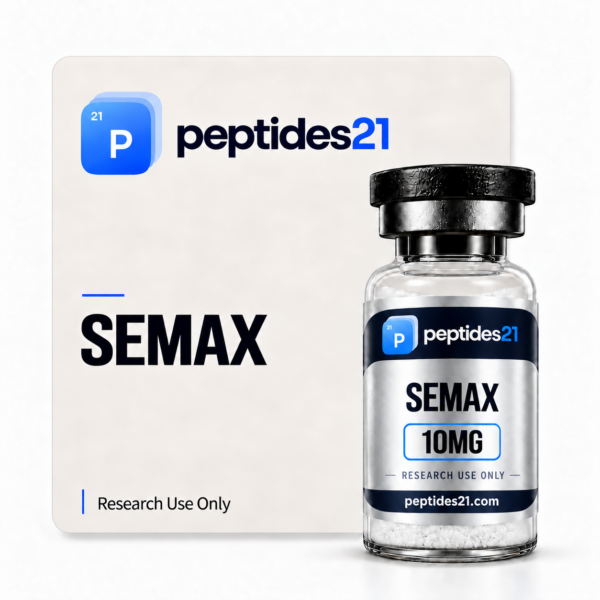
Seven amino acids make up Semax, in the order Met-Glu-His-Phe-Pro-Gly-Pro. Published sources treat it as an ACTH(4-10) — or ACTH(4-7) — derivative to which Pro-Gly-Pro has been appended, the point of the addition being better biological stability than shorter ACTH fragments manage [1,2]. That structural lineage in the ACTH pathway does not make Semax full ACTH, nor is it presented in the literature as a conventional hormonal peptide of the stress axis. Where the research effort has gone is the nervous system: neurotrophic factors, how tissue responds to ischemic injury, gene expression, neuroinflammation and synaptic plasticity [1-6]. A substantial preclinical body exists, joined by clinical publications that are predominantly Russian and in some cases fairly dated. The upshot is a biological foundation worth attention together with methodological and geographical constraints when the work is held against the standards expected of modern multicenter trials [5,7].
Biological Mechanism
Discussion of Semax keeps returning to BDNF-TrkB. As a neurotrophic factor, BDNF figures in neuron survival, in synaptic plasticity and in learning and memory; TrkB is the receptor doing most of the work in conveying part of what BDNF does. Rats given Semax showed altered hippocampal BDNF and altered TrkB expression in one study [1]. In another, the peptide attached specifically and reversibly to cell membranes in the rat basal forebrain, with BDNF measured higher in that region after experimental exposure [2]. Because cholinergic systems, attention and learning are all associated with the basal forebrain, that observation pulled the peptide into cognitive discussion. BDNF aside, Semax has also been put in the frame of immune and inflammatory activity following injury to the brain. Studies of gene expression in cerebral ischemia models recorded the peptide changing expression among genes tied to immunity, to blood vessels, to cytokines and to stress responses [3,4].
Research Evidence
Neuroprotective effects turned up for Semax in a number of animal studies built on cerebral ischemia models. Genome-wide transcriptional analysis published in 2014 recorded altered gene expression in rat brain following focal ischemia, concentrated in immune-system and vascular pathways [3]. A 2017 publication floated neuroimmune crosstalk — traffic between the nervous and immune systems — as a route for some of the effects, its authors reporting shifts among immune-response genes, cytokines and proteins associated with cerebral injury [4]. Proteomics applied in 2021 to an ischemia-and-reperfusion model turned up effects on proteins bearing on inflammation, on cell death and on neural recovery [5]. Human publications exist too, in ischemic stroke: one from 1997 looked at the acute phase of hemispheric stroke, while a 2018 study covered patients at assorted stages of ischemic stroke with attention to BDNF and to functional measures [6,7]. Both are relevant, and both call for cautious reading on account of sample size, language, how much detail is available, and methodology measured against present-day standards.
BDNF, TrkB and Plasticity in the Nervous System
Of the threads running through this literature, the Semax-BDNF one carries the most weight. BDNF has a hand in synaptic plasticity, in whether neurons survive, and in learning and memory; TrkB ranks among the principal receptors carrying those effects. Rat experiments recorded Semax affecting BDNF levels and TrkB expression in brain regions bound up with learning and neural function [1,2]. Reading such findings still calls for restraint. More BDNF in an animal preparation is not a demonstration of sharper cognition in healthy people. What it does signal is neurotrophic potential, and a capacity to shape the environment in which neurons recover. That makes Semax a good fit for research into neural plasticity following stress, ischemia or injury, rather than for the popular conversation about "improving focus." Genomic ischemia work contributes a further layer, since it shows the peptide bearing not only on BDNF but on immune and vascular routes after brain injury [3,4]. Following a stroke, or an experimental occlusion, damage does not come from oxygen deprivation by itself: there is inflammation, immune cells moving in, a compromised blood-brain barrier, altered chemokine and cytokine expression, and changed glial cells. An imprint on immune genes raises the prospect of Semax being folded into that wide injury response. Clinical reports written in Russian, or produced in regional settings, do supply interesting material on ischemic stroke and on neurological rehabilitation [6,7]. The familiar caveats hold: several are old, the samples are small, full protocols are hard to obtain, and holding them up against contemporary late-phase standards is awkward. Human evidence consequently lags behind the strength of the animal and laboratory mechanism. It warrants research interest without delivering any global account of efficacy, of safety, or of which populations might be suitable.
Safety & Regulation
What is known about Semax safety does not extend as far as it does for medicines taken through large international development programs. Tolerability has been reported clinically, but nothing resembling a large long-term dataset across multiple populations exists — the kind needed to catch rare risks or interactions across the range of neurological and psychiatric conditions. Per the FDA, compounded preparations containing Semax may raise issues of immunogenicity, of aggregation, of peptide-related impurities and of how the active substance is characterized, with human safety data for the proposed routes of exposure described as limited or insufficient [8]. As a research subject, then, Semax is valuable for work on neurotrophins, on neuroinflammation and on ischemia. Clinically, the evidence does not reach far enough to support broad statements about cognitive improvement or about treating neurological conditions generally.
Reaching the Brain, and Biological Breakdown
One thing that marks Semax out from many peptides studied in the nervous system is the interest some publications take in the intranasal route of administration. Preclinical reports indicate that the peptide, or its metabolites, can get to the nervous system, and also that breakdown happens comparatively fast [1,2]. Quick degradation is not automatically a liability, given that short metabolites may carry activity of their own, though it does make pinning the mechanism down harder. Any question about cognition is best split three ways: effects on neurotrophic factors, effects on recovery after injury, and effects in people who are healthy. Evidence is firmer on the first two, above all in ischemia models and in readouts of BDNF, TrkB and the neural immune response [1-5]. Broad assertions about attention or memory improving in healthy people belong to the third category and need larger, controlled, more independent studies. Safety reasoning runs in parallel: regional data, or experience of use within one country, is no substitute for wide regulatory assessment. Interactions with psychiatric medication, behavior across different neurological diseases, extended exposure and consistency of manufacturing all stay on the list of open questions [8]. Semax is thus a neuroactive peptide of real interest whose credibility differs sharply depending on which research area is being discussed. One last distinction is worth drawing, between acute neuroprotection and lasting cognitive gain. A compound might limit ischemic damage in an animal model and still do nothing for learning in a healthy person. Findings should accordingly be weighed against the clinical setting that produced them, not swept together under a blanket heading of "nootropics."
Summary
Most Semax research sits in the BDNF-TrkB pathways, in cerebral ischemia and in the neuroinflammatory response [1-5]. Clinical publications exist, though scope and methodology constrain them [6,7], and effect size, safety over the long run, formulation quality and whether the findings reproduce all remain open. The substance is intended for laboratory research use only.
Key Research References
- Dolotov O.V. et al. Semax, an analog of ACTH(4-10) with cognitive effects, regulates BDNF and TrkB expression in the rat hippocampus. Brain Research, 2006. DOI: 10.1016/j.brainres.2006.07.108. sciencedirect.com
- Dolotov O.V. et al. Semax, an analogue of adrenocorticotropin (4-10), binds specifically and increases levels of brain-derived neurotrophic factor protein in rat basal forebrain. Journal of Neurochemistry, 2006. PMID: 16635254
- Medvedeva E.V. et al. The peptide Semax affects the expression of genes related to the immune and vascular systems in rat brain focal ischemia. BMC Genomics, 2014. PMID: 24661604
- Medvedeva E.V. et al. Semax regulates expression of immune response genes during ischemic brain injury in rats. Molecular Genetics and Genomics, 2017. PMID: 28255762
- Sudarkina O.Y. et al. Brain Protein Expression Profile Confirms the Protective Effect of Semax in a Rat Model of Cerebral Ischemia-Reperfusion. International Journal of Molecular Sciences, 2021. PMID: 34201112
- Gusev E.I. et al. Effectiveness of Semax in acute period of hemispheric ischemic stroke. Clinical and electrophysiological study, 1997. PMID: 11517472
- Gusev E.I. et al. The efficacy of Semax in the treatment of patients at different stages of ischemic stroke, 2018. PMID: 29798983
- U.S. Food and Drug Administration. Safety risks associated with certain bulk drug substances nominated for use in compounding. Entry for Semax. FDA.gov


Reviews
There are no reviews yet.