A non-standard research blend of peptides linked to the matrix, cell migration and tissue healing
Overview
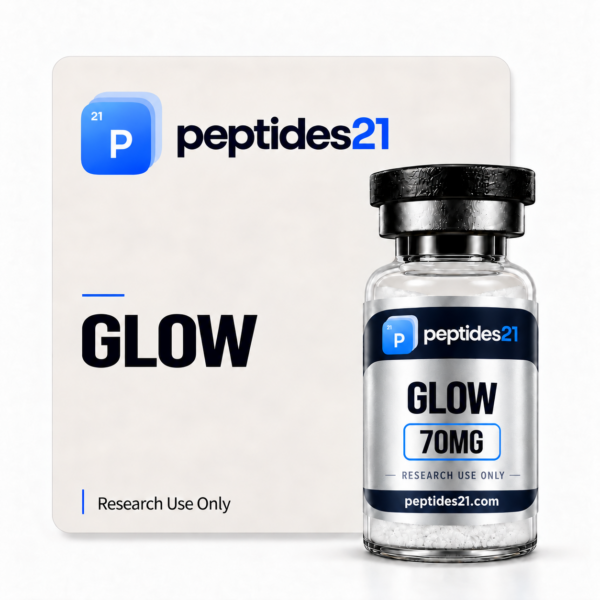
The label GLOW does not designate a single peptide, is not a generic drug name and does not correspond to any standard regulatory formulation. Commercially, and in non-regulated research discussion, it is usually attached to a mixture of three peptides: GHK-Cu, BPC-157 and TB-500. Since neither the composition nor the component ratios are consistent between products, "GLOW" is best treated as the name of a blend rather than of a defined molecule. Each of the three components arrives from a separate research literature. Work on GHK-Cu has centered on remodeling of the extracellular matrix, collagen and fibroblasts [1-3]. Work on BPC-157 has centered on preclinical models of tissue, blood-vessel and gastrointestinal healing [4,5]. TB-500, a fragment related to Thymosin beta-4, has been examined in connection with actin, cell migration and healing [6]. No controlled clinical study demonstrates the efficacy or safety of GLOW as a blend, so any claim of "synergy" between the components remains, at this stage, a biological hypothesis rather than a demonstrated clinical outcome.
Biological Mechanism
What underpins the blend is a partial overlap between three areas of tissue-repair biology. GHK-Cu, a peptide-copper complex, has been linked in cell and animal work to increased synthesis of collagen and glycosaminoglycans, to fibroblast activity and to remodeling of the extracellular matrix [1-3]. BPC-157 has been linked in preclinical models to cell migration, the vascular response, nitric oxide pathways and angiogenesis; some studies point to involvement of VEGFR2/Akt/eNOS, a pathway that may be relevant to healing but that also calls for caution in biological contexts where angiogenesis is not desirable [4,5]. TB-500 corresponds to the actin-binding region of Thymosin beta-4. Because actin is essential for cell movement, change of shape and migration, studies of the full Thymosin beta-4 lend support to the rationale for an effect on healing processes. TB-500 is not necessarily identical to the full protein, however, and carrying data across from one to the other requires caution [6].
Research Evidence
The evidence behind GLOW is evidence about its components, not about the blend. GHK-Cu is supported by cell and animal work and by small dermatological preparations that point to activity related to collagen and the matrix [1-3]. BPC-157 has a comparatively broad preclinical literature but very little high-quality human data [4,5]. For TB-500 the direct evidence base is thinner still, and much of the reasoning leans on research into the full Thymosin beta-4 [6]. No randomized study shows that putting the three substances together improves a clinical outcome beyond what each does alone, and none characterizes the pharmacokinetic or safety interactions of the blend. The distinction matters: three components that each have a research mechanism do not by themselves add up to a proven combined treatment. A combination might add an effect, might change nothing, or might produce interactions nobody anticipated.
Has a "Synergy" Been Demonstrated?
Calling something synergy requires experimental proof that the combined effect is significantly larger than the effect expected from each component separately. No such basis currently exists for GLOW. The pathways do overlap — GHK-Cu with remodeling, BPC-157 with angiogenesis and cell migration, Thymosin beta-4/TB-500 with actin and cell migration. That overlap may sound theoretically complementary, yet it may equally amplify biological pathways that are not desirable in every situation, angiogenesis and cell growth among them. An accurate scientific description of GLOW therefore reaches for terms such as "combined rationale" or "research blend," instead of presenting a combined advantage as something already established experimentally.
Safety & Regulation
Every one of the three components raises its own safety questions, and the blend layers further uncertainty on top. The FDA notes concerns regarding compounded products containing BPC-157 and TB-500, including immunogenicity, aggregation, peptide-related impurities and the absence of sufficient human exposure data [7]. For GHK-Cu the agency distinguished between different routes of exposure and raised particularly significant concerns regarding injectable products, covering quality, immunogenicity and limited human data [8]. Once three substances share a single product, the safety assessment stops being the sum of three separate assessments. Data are then needed on combined stability, degradation products, chemical interactions, sterility and batch-to-batch uniformity. And because GLOW is not an approved drug and is not a standard name, no single regulatory framework specifies what every product carrying the name must contain.
Formulation, Stability & Quality
GHK-Cu is a metal complex, while BPC-157 and TB-500 are peptides with chemical properties of their own. Putting them into one formulation may influence pH, stability, metal binding, aggregation and degradation. Absent a dedicated formulation study, no one can assume that a given blend stays as stable as each component does separately. The name GLOW also guarantees no fixed ratio between the components, and shifting the ratio shifts relative exposure to each molecule and therefore the activity and risk profile as well. A result obtained with one product cannot be carried over to another merely because both are called GLOW. Scientifically, product quality belongs to the evidence rather than to marginal technical detail: purity, identity, sterility, stability and degradation products bear directly on what has actually been tested and on what the possible risk is.
Summary
GLOW is a non-standard name for a research blend, usually of GHK-Cu, BPC-157 and TB-500, rather than a single peptide. Separate studies of the extracellular matrix, cell migration and tissue processes supply the rationale for combining them [1-6], but no controlled clinical studies cover the blend itself and nothing proves synergy, efficacy or safety. Alongside the limits of the evidence sit questions of formulation, quality and regulation [7,8]. The substance is intended for laboratory research use only.
Selected Research Sources
- Maquart F.X. et al. Stimulation of collagen synthesis in fibroblast cultures by the tripeptide-copper complex GHK-Cu. FEBS Letters, 1988. PMID: 3169264
- Maquart F.X. et al. In vivo stimulation of connective tissue accumulation by GHK-Cu in rat experimental wounds. Journal of Clinical Investigation, 1993. PMID: 8227353
- Pickart L. et al. GHK peptide as a natural modulator of multiple cellular pathways in skin regeneration. BioMed Research International, 2015. PMID: 26236730
- Chang C.H. et al. BPC 157 enhances growth hormone receptor expression in tendon fibroblasts and improves tendon healing. Journal of Applied Physiology, 2011. PMID: 21030672
- Seiwerth S. et al. Stable gastric pentadecapeptide BPC 157 and wound healing. Frontiers in Pharmacology, 2021. PMID: 34267654
- Esposito S. et al. Synthesis and characterization of the N-terminal acetylated 17-23 fragment of thymosin beta-4 identified in TB-500, a product suspected to possess doping potential. Drug Testing and Analysis, 2012. PMID: 22962027
- U.S. Food and Drug Administration. Certain Bulk Drug Substances for Use in Compounding that May Present Significant Safety Risks. Entries for BPC-157 and Thymosin beta-4 fragment (TB-500).
- U.S. Food and Drug Administration. Current compounding safety information and 503A evaluation materials for GHK-Cu.


Reviews
There are no reviews yet.